People skip gutter cleaning here because the climate feels dry. The airport averages around 12–13 inches of precipitation. May is the wettest month, not June thunderstorm season like the Front Range cities to the south. That statistic is true and still misleading. Seventy inches of snow (a normal year; mountain lots see more) has to leave the roof somehow. When it leaves, it needs an open trough and an open pipe. A trough packed with cottonwood, granules, and last year’s ice is a dam.
This page covers what is actually in Casper gutters, when to clean, what a professional visit should include, DIY limits on ice and two-story eaves, and the price ranges that are honest for Natrona County — not a $49 coupon that only blows the front lip.
What we pull out of Casper gutters
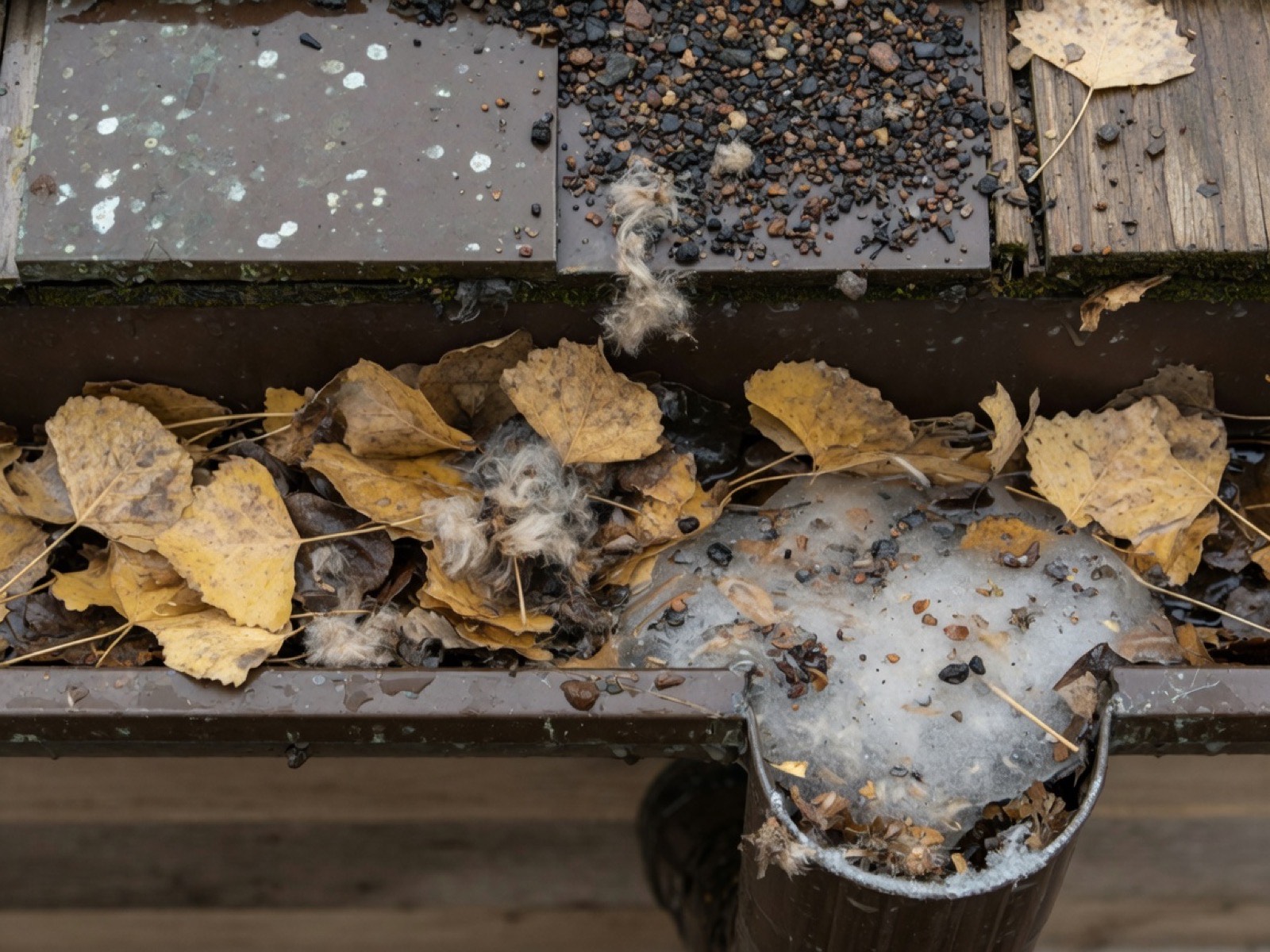
- Cottonwood seed and catkins. Fine, wet, and it felts. Neighborhoods with mature trees load gutters in late spring even when the rest of the yard looks clean.
- Shingle grit. Dark granules from asphalt roofs. They settle at outlets and mix with ice. Harmless in small amounts; enough of them and the downspout is a sand plug.
- Leaves and wind-blown weeds. Not a Midwestern volume, but a November wind along the North Platte will fill a trough in an afternoon.
- Ice remnants. Last thaw’s ice becomes this freeze’s anchor. You cannot “flush” a frozen outlet with a garden hose in January and call it done.
Why fall cleaning is ice-dam insurance
Ice dams start in the attic — heat leaks, snow melts, water refreezes at the eave. A clogged gutter makes the eave worse. Meltwater has nowhere to go, so it sits, freezes, and climbs. Casper design notes even flag ice barrier as something you add when there is a history of ice damming, typically at eaves and valleys. If your house has that history, going into December with a full trough is how you write the next chapter.
The practical schedule for most Casper, Mills, and Evansville homes:
- Late fall (after leaf drop, before consistent freeze): the important one. Scoop, flush, confirm downspouts run.
- Late spring (after seed drop) on tree lots: Paradise Valley, Garden Creek, older streets with cottonwoods.
- After a major wind or hail event: twigs and granules, plus a chance to see if hangers moved. That may turn into a repair visit.
Treeless ranches in Bar Nunn or on open county lots can often do once a year. Two-story homes with trees should not gamble on once every three years.
What a real cleaning includes
A leaf blower aimed at the front lip is not a cleaning. Water still sits in the trough, and the downspout is still packed. A complete visit:
- Protect landscaping and keep debris off walks — Casper freeze-thaw turns wet leaves on a sidewalk into a rink.
- Hand-remove packed material from the trough. This is the part that takes time.
- Flush toward each outlet with enough water to prove the pitch.
- Snake or flush downspouts until they run freely at the discharge. If they don’t, that is a downspout problem, not a “we’ll get it next time.”
- Note sagging, pulled hangers, open miters, soft fascia, and missing splash blocks. Cleaning is also an inspection.
- Haul the debris off. Leaving wet piles against the foundation is how you undo the job.
Cleaning with gutter guards
Guards reduce how often you empty the channel. They do not end the appointment. Cottonwood felts on micro-mesh. Screens clog from below. Helmet-style covers ice over. A Casper guard cleaning is: clear the surface, check clips after wind, and verify the downspout still runs. If every cleaning requires the guard to come off, you have the wrong guard — see gutter guards.
DIY vs hiring it out
A one-story ranch with a stable ladder, dry weather, and no ice is a reasonable DIY. Wear shoes that belong on a roof you are not actually walking on — stay on the ladder, don’t creep the shingles. Use a scoop, not your hands against hidden metal edges. Flush with a hose and watch the discharge.
Hire it out when any of these are true:
- Two-story, steep pitch, or a house on a slope (south Casper toward the mountain, Glenrock lots).
- Ice in the trough. Chipping ice from a ladder is how people fall and how lips get bent.
- You already know the fascia is soft. Extra weight on a rotten board is a bad idea.
- You want the inspection notes, not just a cleaner trough.
Price ranges
Wyoming cleaning is often a per-visit number, not per foot. For planning:
- Typical one-story Casper ranch, modest debris: often $125–$250.
- Two-story, heavy trees, or a large footprint: $200–$400+.
- Guards that need surface cleaning: similar band; more if panels have to come off.
- Add-on repairs found on the visit (hangers, elbows): quoted separately, often $150–$400 extra if you approve them.
If a number is far below $100 for a whole house, ask what they skip. If a number looks like an install, ask whether they bundled repairs you did not request.
What cleaning will not fix
A clean trough still overflows if it is undersized for melt or if there are too few outlets. It still leaks if a miter is open. It still pulls off in wind if the hangers are spikes in oval holes. Cleaning is maintenance. Chronic overflow on a clean system is an install or downspout-count conversation. Chronic staining behind a clean gutter is drip edge or fascia.
Safety notes we will not skip
Aluminum ladders and frozen ground, chinook wind, and metal eaves at −10°F are a bad mix. We would rather reschedule a cleaning than put someone on an iced ladder for a non-emergency. If water is already in the house, that is a different visit — temporary diversion, then a proper clean when the eave is safe.
Related reading
Gutter guards · Repair · Downspouts · Installation