A leaking gutter in Casper is easy to ignore in July. Annual rain is only about 13 inches. Then October cottonwoods load the trough, November freeze-up turns that debris into a dam, and the first January thaw puts water behind the fascia. By the time you see staining on the siding, the board may already be soft. Repair, done early, is a few hundred dollars. Repair, done after the fascia fails, is a different job.
This page is the decision tool: what we see on Natrona County houses, what a repair can honestly fix, when you should stop and read seamless installation instead, and the price ranges a homeowner should expect before anyone is on the roof.
How Casper gutters actually fail
The climate is written into the failure modes. City design data calls for 30 psf snow, severe weathering, a 3-foot frost line, and a −10°F winter design temperature. Wind is Exposure C. Freeze-thaw cycles in this part of Wyoming number well over a hundred in a typical year. Those numbers show up on the eave as four patterns.
1. Wind pull-off and “walking” fasteners
Old spike-and-ferrule gutters were driven through the trough into the fascia. Every gust flexes the spike in an oval hole. After enough 40–60 mph events, the trough rolls forward or sags between spikes. Hidden hangers that have backed out do the same thing, just slower. You will notice gaps at the drip edge, a wavy front lip, or a whole section hanging after a blow. That is a fastening problem first. If the metal is still good, you can re-hang. If the fascia is punky, you are not allowed to skip the wood.
2. Ice in the trough and at the miter
Ice expands. Miters, end caps, and outlet collars are the first seams to open. Sealant that was fine in a Denver spring is not fine after a Casper January. A “caulk it again” repair can work for a season if the joint is still tight. Once the metal is fatigued or the corner is crushed, you recut and replace the fitting.
3. Frozen downspouts
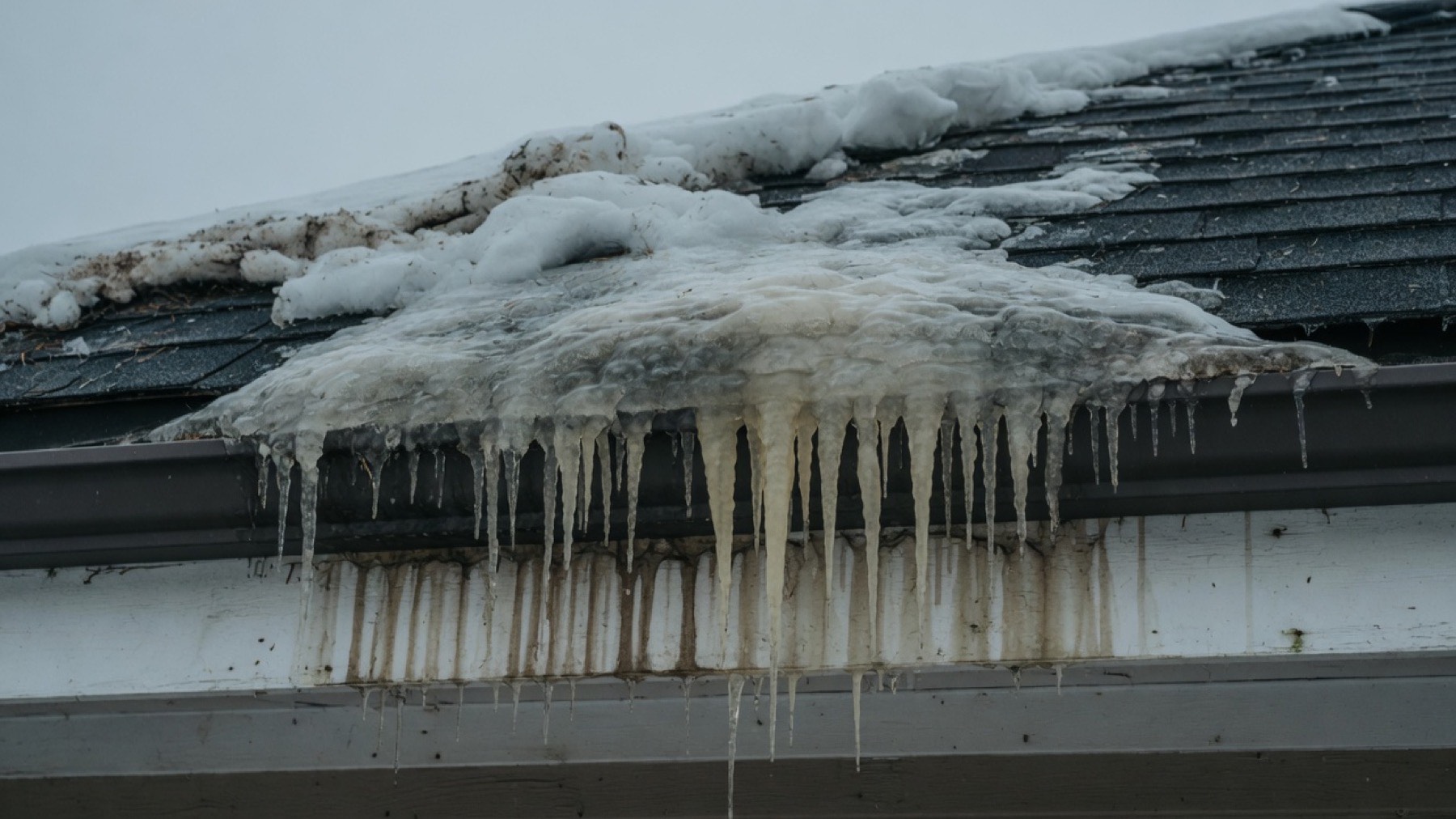
Meltwater hits a downspout that is still a cylinder of ice. Pressure has to go somewhere: the elbow splits, the outlet blows, or water sheets behind the gutter. Homeowners often describe this as “the gutter leaks only when it warms up.” That is a downspout repair as much as a trough repair. Heat cable is sometimes part of the answer on chronic freeze-ups; clearing the pipe and adding a larger 3x4 is the other part.
4. Fascia rot under a “small leak”
Water that overshoots or sits against the board does not stay a paint issue. Casper’s freeze-thaw drives moisture into the grain. The next hanger has nothing solid to bite. We will not hang a new section on rot and call it a repair. If you can push a screwdriver into the fascia, budget wood. The gutter is the symptom.
Leak, overflow, or pitch — they look the same from the ground
Streaks on siding get called a leak. Sometimes the trough is full of cottonwood and shingle grit, so water never enters. That is overflow, and the first visit is a cleaning, not a tube of sealant. Sometimes the gutter is clean but dead-flat or pitched the wrong way, so water sits at a low spot and finds a seam. Sometimes the drip edge dumps behind the back edge of the gutter. A photo of the eave during a melt, plus a photo of the inside of the trough, usually sorts this before anyone drives out.
What a proper Casper repair includes
A repair visit should not be “we caulked it, good luck.” Depending on the house, the work looks like this:
- Reset or replace hangers; add hangers where spacing is too wide for wind and ice load.
- Reseal or replace miters, end caps, and outlets with sealant rated for movement and cold.
- Rebuild a crushed corner rather than smearing over it.
- Replace split elbows, frozen sections of downspout, and missing fasteners at the wall.
- Add or correct pitch toward outlets when a run is holding water.
- Install a short new seamless section if one eave is failed and the rest of the house is fine.
- Flag fascia, soffit, or drip-edge problems instead of hiding them.
Sectional gutters with a leak at every joint are not a repair project. You would be recaulking the house twice a year. That is a replacement conversation.
Repair vs replace
| Condition | Usually repair | Usually replace |
|---|---|---|
| Fasteners | A few popped hangers, metal still straight | Spikes throughout, trough rolling off the fascia |
| Seams | One miter or outlet | Sectional joints every 10 feet, all opening |
| Metal | Local dent, small split at an elbow | Widespread cracking, rust-through (steel), color failure plus leaks |
| Fascia | Sound wood, maybe a paint stain | Soft board on more than one eave |
| Age / type | Seamless aluminum under ~15–20 years, one problem | Vinyl, mixed metals, or a system already patched twice |
There is a gray zone: a 25-year-old seamless run with two bad corners. If the color still matches and the trough is heavy enough, repair is rational. If you also want guards or a change from 5-inch to 6-inch, do not pour money into the old trough. Replace once.
Wind damage after a Casper blow
After a high-wind day you may find a downspout in the yard, a section twisted at the hanger, or the whole front lip peeled. Photograph everything before you move it. A repair can often reuse the metal if it is not creased at the hangers. Creased K-style does not sit flat again; that piece gets replaced. If the same eave has come down twice, the answer is not a stronger zip tie. It is hanger schedule, fascia, and maybe a heavier gauge.
Pricing ranges for repairs in this market
Wyoming gutter work is often quoted per job for repairs and per foot for replacement. Planning numbers, not a bid:
- Small leak / reseal / a couple of hangers: often $150–$400 if access is easy.
- Downspout / elbow / outlet rebuild: $150–$450 per location, more for two-story or buried drains.
- Re-hang a run, add hangers, correct pitch: $300–$900 depending on length and height.
- Section swap (one eave): can land in the high hundreds to low thousands once you include tear-off and color-matched coil.
- Fascia board replacement: its own line, often $15–$40+ per linear foot depending on height, wrap, and how much soffit is involved.
Emergency call-outs in a freeze, after-hours, or same-day work cost more. A number that looks like a full-house replacement but is labeled “repair” is a red flag — get the scope in writing.
What to send so we can tell repair from replace
You do not need a perfect inspection. Phone photos from the ground plus one from a second-story window if you have it:
- The whole eave, so we can see sag and missing sections.
- Close-up of the problem corner, streak, or pulled hanger.
- Inside the trough if you can do it safely — debris vs a split seam.
- The downspout discharge: ice, splash block, or dumping at the foundation.
- Any interior stain on the ceiling or rim joist, if the leak has already come inside.
Address and a note on when it drips (only on thaw, only in wind, all the time) is enough to route the job. If it is a full-house sectional system from the 1990s, we will probably steer you to installation before we sell you three repairs.
Can you wait until spring?
If the trough is off the house, no. If water is in the wall, no. If you have a slow drip on a one-story and the fascia still sounds solid, a scheduled spring repair is reasonable — as long as you keep the downspouts open so a mid-winter thaw does not fill the wall. Do not use a roof rake as a gutter tool; it bends the lip and creates the next leak.
Related reading
Seamless installation · Downspouts · Cleaning · Guards