Gutter guard ads are written for places where the problem is leaves in a rainstorm. Casper’s problem set is different. Rainfall is only about 13 inches a year. Cottonwoods throw seed fluff that behaves like felt. Wind drives that fluff, plus pine needles from Casper Mountain lots, into every opening. Then winter arrives: 30 psf design snow, freeze-thaw, and meltwater that needs a clear path off the roof on a 40-degree afternoon while the eave is still below freezing.
A guard that keeps the trough empty can help that meltwater move. A guard that clogs on top becomes a second roof edge — water sheets over the front or, worse, behind the back lip into the fascia. We will sell a guard when the house and the gutter underneath can support it. We will not tell you it makes ice dams impossible.
What actually lands in a Casper gutter
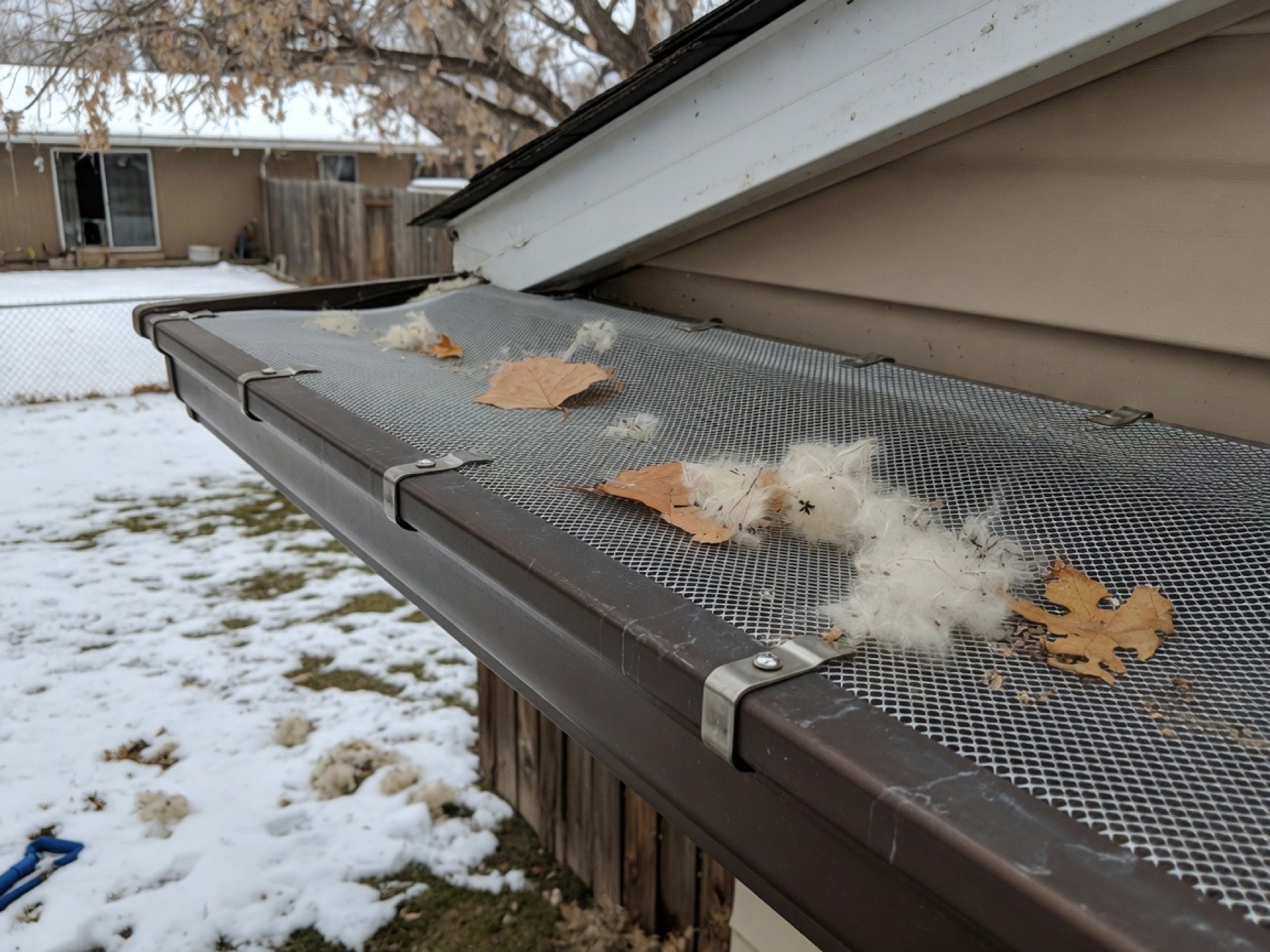
- Cottonwood seed. Fine, wet, and excellent at felting over mesh. Neighborhoods with mature trees — parts of Paradise Valley, older east-side streets, lots along the river — see this every June.
- Shingle grit. Granules wash off asphalt roofs and settle in the trough. Fine mesh blocks them from the pipe; they still sit on top of a guard.
- Leaves and twigs after a wind event. Not a rainforest volume, but enough to plug an outlet if they sit through freeze-up.
- Ice. Not debris, but it uses debris as an anchor. A clogged screen is a great ice fence.
Guard types, without the brochure language
Screens (wide openings)
Cheap, easy, and the first thing wind peels off a Casper eave. Large openings let seed and grit into the trough, where you cannot see the clog until the downspout backs up. Fine as a temporary DIY on a one-story ranch you already clean. Poor as a “never clean again” product. Plastic screens also get brittle in this cold.
Mesh (medium)
Better at leaves, still open enough for seed and needles. Debris can bridge across the top and shed water over the lip in a hard melt. Metal mesh lasts; foam-adjacent products that sit down in the trough are a freeze-thaw sponge. We do not like foam inserts in Natrona County.
Micro-mesh (stainless or quality aluminum)
The honest premium pick for mixed debris. Openings small enough that most seed and grit stay on top, water still enters if the surface is not glazed with ice or a felt of cottonwood. Stainless holds shape under snow better than light aluminum. It is not maintenance-free: you still sweep or blow the surface, especially after seed drop. Installed cost in many markets runs roughly $10–$20+ per linear foot on top of a sound gutter, sometimes more for name-brand micro-mesh.
Reverse-curve / “helmet” covers
Water is supposed to cling around a curve while leaves slide off. In snow country these profiles can grow a thick ice cap. Some homes do fine; some ice-dam badly. If your eave already grows ice dams with an open trough, a helmet is not the first experiment. Fix attic heat loss and keep the downspout open first.
Brush inserts
They pack with grit and seed, then freeze into a dirty bottle brush. Skip them here.
| Type | Casper fit | Typical installed range |
|---|---|---|
| Plastic / light screen | Poor — wind and cold | Low materials cost; not worth a pro trip |
| Metal mesh | Fair on simple roofs with few cottonwoods | Often $7–$14 / ft |
| Micro-mesh | Best of the common options if the gutter is sound | Often $10–$20+ / ft |
| Reverse-curve | Case by case; ice history matters | Usually at the high end |
Ice dams: what a guard can and cannot do
Ice dams form when heat leaks into the attic, snow on the upper roof melts, and water refreezes at the cold eave. A clogged gutter makes that eave even colder and gives ice a trough to lock into. A clean, open gutter (or a guard that truly keeps the channel empty) removes that one contributing factor. It does not replace insulation, baffles, or ice-and-water shield on a house that already leaks at the eaves.
Casper’s own climatic criteria say ice barrier is not automatically required unless there is a history of ice damming. If you have that history, treat the roof edge as a system: ventilation, insulation, maybe heat cable on a chronic valley, and a gutter that drains. A $3,000 guard on a $200 insulation problem is the wrong order.
Install guards on a gutter that already works
Guards do not straighten a sagging trough, add hangers, or fix rotten fascia. They add weight and a new wind profile. The sequence on a Casper house should be:
- Confirm the gutter is pitched, hung, and sized — 5-inch vs 6-inch is a real choice when you reduce inlet area. See installation.
- Fix leaks, pull-off, and fascia. See repair.
- Make sure downspouts can take melt. A guarded trough with a frozen 2x3 is still a waterfall. See downspouts.
- Then choose a guard you can inspect, not a sealed mystery.
If the existing gutter is a sectional vinyl kit, do not guard it. Replace it, then guard the new run if trees justify it.
Do you even need guards in Casper?
Plenty of high-plains ranches with no trees do fine with a fall cleaning and an open trough. Guards earn their keep when:
- You have cottonwoods, aspens, or pines close to the roof.
- The house is two-story and you do not want a ladder twice a year.
- You already clog every June and October even after cleaning.
- You are hanging new 6-inch seamless and the incremental cost is lower as a combo job.
They are a weaker buy on a treeless Bar Nunn or Mills ranch that only sees wind-blown weed bits. Spend that money on hangers and downspout extensions first.
Maintenance with guards
“Maintenance-free” is marketing. Plan on a visual check in late fall and after heavy seed drop. Sweep or blow the surface. Check that clips have not lifted in wind. Flush a downspout with a hose from a cleanout if one is built in. If water is sheeting over the front during a thaw, the surface is glazed or felted — clean it, do not add more product on top.
Price ranges
For a typical 150–180 foot Casper ranch, a quality micro-mesh job often lands in a planning band of $1,500–$4,000, assuming the gutter underneath does not need a rebuild. Screens are cheaper and usually a waste. Doing guards with a full seamless replacement is more efficient than a second mobilization. Two-story pricing is higher because of access, not because the mesh costs more.
Related reading
Gutter cleaning · Seamless installation · Repair · Downspouts