Most “gutter installation” pages are written for a rainy suburb. Casper is not that market. The city sits at about 5,150 feet. Design snow load is 30 pounds per square foot. One- and two-family dwellings are designed for a 115 mph, 3-second gust under Exposure C — open terrain, not a sheltered forest. Annual precipitation is only around 12–13 inches, with May the wettest month. Snowfall in a normal year is on the order of 70 inches at the airport, more on Casper Mountain and the south side of town.
That combination is why a new gutter here is not a cosmetic trim piece. It is a snowmelt trough, a wind-loaded beam, and the last chance to keep water out of the fascia and the basement. If you are comparing a box-store sectional kit to a seamless run formed in the driveway, the seamless system wins on leak points alone. If you are deciding 5-inch versus 6-inch, aluminum versus steel, or whether to repair the old trough, the rest of this page is the Casper version of that conversation.
What seamless actually means on a Natrona County roof
Seamless gutters are roll-formed on site from a coil of painted metal. One length runs from corner to corner, so you do not have a joint every ten feet. Corners still need miters. Outlets still need downspouts. End caps still need sealant that can handle −10°F design winters and July sun. “Seamless” is not magic. It is fewer seams in the long runs — the places sectional gutters leak first after a few freeze-thaw seasons.
On a Casper ranch, those long eaves are exactly where wind gets a purchase. A sectional gutter with slip joints is a row of weak spots. Ice expands in those joints. Chinook wind works the fasteners. By year five you have streaks on the siding and a fascia board that is soft when you press it. Seamless does not prevent ice. It does remove the joint that ice loves to open.
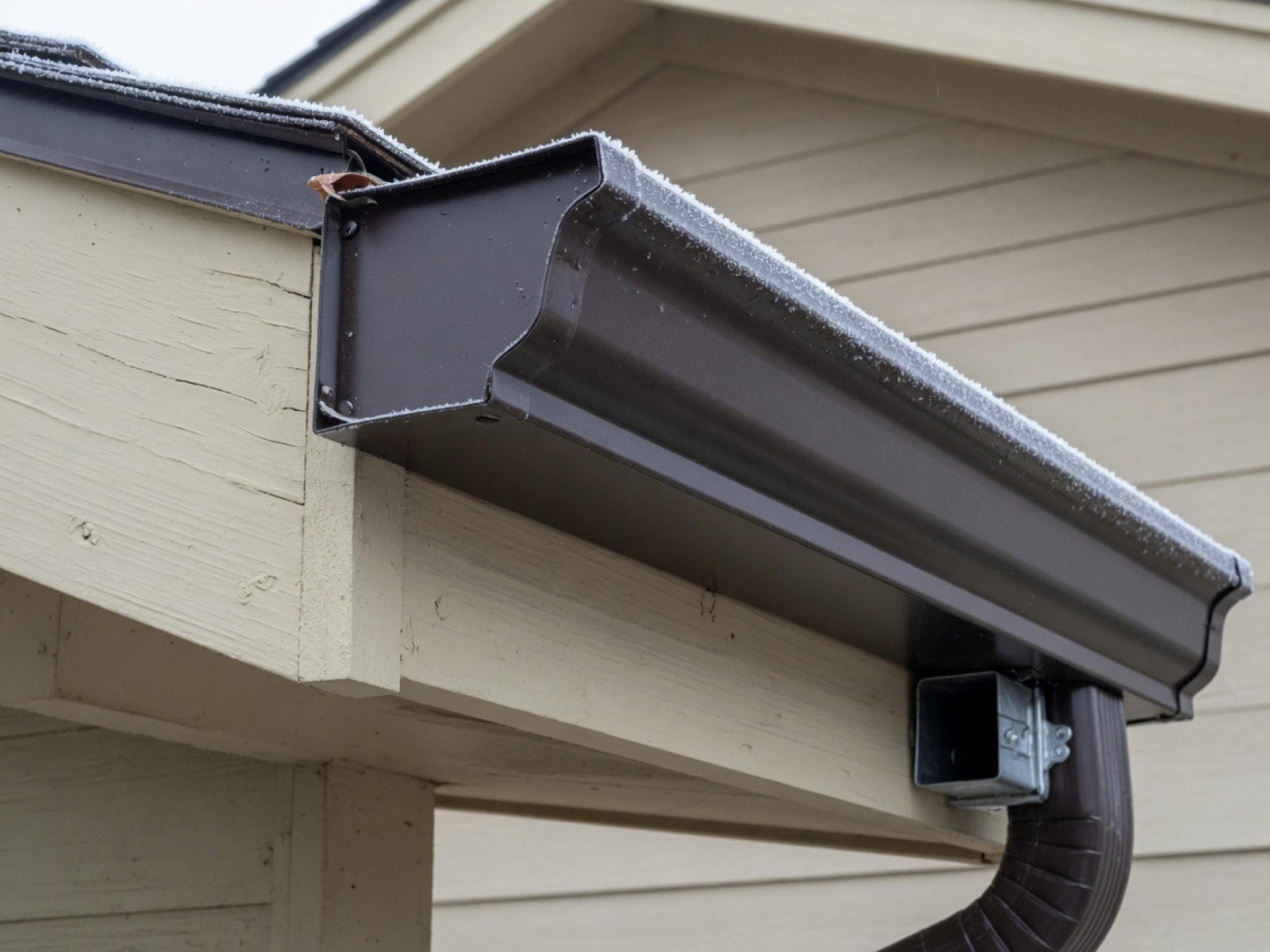
5-inch vs 6-inch: Casper is a melt problem, not a rainforest
Five-inch K-style is the residential standard in much of the country. It is cheaper, easier to hide on a small eave, and plenty of trough for a modest roof if water arrives as rain. Casper water often arrives as melt. A dark shingle roof on a 40-degree March afternoon can unload a winter of snow in a few hours while the downspout elbow is still a plug of ice. Capacity in that hour matters more than the annual rainfall total.
Six-inch K-style carries on the order of 40–50% more water than 5-inch. It also clogs a little slower because the opening is wider. The extra cost is usually a few dollars per linear foot, not a different class of project. We tend to recommend 6-inch when any of these are true:
- A large roof area or a steep pitch dumping into one eave (common on split-levels and newer south Casper builds).
- A house that already overflows during thaw, even with clean gutters.
- Heavy tree cover — Paradise Valley, Garden Creek, lots with cottonwoods — where debris cuts effective capacity.
- A plan to add gutter guards. Some guard styles reduce inlet area; starting with 6-inch leaves more room.
Five-inch is still the right call on a small one-story ranch with a simple roof, short runs, and enough downspouts. The mistake is choosing 5-inch because “Casper doesn’t get much rain.” Melt does not care about the annual average.
| Size | Best fit in Casper | Watch-outs |
|---|---|---|
| 5" K-style | Smaller ranches, simple eaves, good downspout count | Overflows on big melts if undersized or half-clogged |
| 6" K-style | Larger roofs, steep pitches, tree lots, homes adding guards | Slightly heavier look on a small fascia; worth it on most two-stories |
| Half-round | Historic or custom homes where the profile is the point | Fewer local machines; hanging and outlets take more care in wind |
Aluminum, steel, copper — and why vinyl is a bad Casper bet
Aluminum (most homes). Seamless aluminum in a heavier residential gauge is the default. It does not rust, it takes a baked-on color, and it is light enough that a proper hanger schedule can hold it in wind without overloading a tired fascia. It will dent if a ladder or a sliding ice sheet hits it. In this climate that is an acceptable trade. Typical installed range for aluminum seamless work in the region is roughly $8–$18 per linear foot, with 6-inch, two-story work, and color-matched extras toward the high end.
Steel. Galvanized or galvalume steel is stiffer. On a long, windy eave, stiffness is a feature: the trough is less likely to twist or pull a hanger when ice sits in it. Steel is heavier, so the fascia and the hanger choice have to be real, not a clip every four feet. It will eventually show rust if the coating is cut or the inside stays wet against debris. Steel often prices in a similar band to better aluminum, sometimes a little higher, depending on coil and labor that week.
Copper. Copper is the 50–100 year answer. It looks right on a high-end custom house and it does not need paint. It is also $25–$50+ per linear foot installed in most markets, and you want an installer who solders corners instead of caulking them. For a typical Casper ranch, copper is a want, not a need. For a house you plan to keep for decades and already spend on accordingly, it is a legitimate spec.
Vinyl / PVC sectional. Skip it here. Casper winters are designed around −10°F; actual cold snaps go far lower. Vinyl gets brittle, fasteners oval out, and freeze-thaw opens every joint. The money you save in year one shows up as fascia repair in year four.
The install process we expect on a Casper house
A good installation is mostly unglamorous. The order below is what we want to see. If a bid skips fascia, hanger spacing, or downspout discharge, it is not a complete bid.
- Measure the eaves and map the roof. Linear footage, inside and outside corners, height, and where water actually concentrates. A 1,400-square-foot ranch is not automatically “150 feet of gutter.” Valleys and long back sides matter.
- Inspect fascia and drip edge. Gutters hung on rotten wood will pull off in the first real wind. Soft fascia is a repair line item, not a surprise on install day. If the drip edge is missing or kicked up, water can miss a new trough entirely.
- Pull the old system. Old spikes, rusty screws, and failed sealant come off. This is when you see the hidden rot and the insect damage along the board.
- Form the runs on site. Coil matches the color you picked. Lengths are cut to the eave so you are not splicing in the middle of a 40-foot run.
- Hang with a schedule that respects wind and ice. Hidden hangers through the front and into fascia, typically every 16–24 inches — closer on two-story, high-wind, or 6-inch runs. Spike-and-ferrule from 1988 is how gutters walk off a Casper eave. Pitch is a slight slope toward each outlet, not a roller-coaster.
- Outlets, downspouts, elbows, extensions. More outlets beat a bigger trough that still dumps into one frozen 2x3. Discharge has to land away from the foundation. See downspouts and extensions.
- Water test and walkaround. A hose at the ridge is not fancy, but it shows pitch problems before the first thaw does.
Hangers, wind, and pull-off
Casper is one of the windier cities in the country. Sustained 30 mph days are normal. Storm gusts in the 50–60 mph range show up in the climate summaries. A gutter full of ice is a sail plus a weight. The failure mode we see is not “the aluminum tore.” It is “the fasteners walked out of tired fascia” or “the spikes elongated their holes.”
Hidden hangers that screw into solid fascia, spaced tightly, are the fix. On a questionable board, sister a new fascia strip first. On a two-story west-facing eave, do not bargain the hanger count down. The extra clips are cheap compared with a trough in the yard after a March blow.
When to repair instead of replace
Replacement is the right call when the trough is a sectional kit with open joints, the color is shot, the hangers are spikes, or more than a couple of corners are cracked. Repair is the right call when the runs are still sound and the problem is local: a popped hanger, an outlet that froze and split, a seam that can be resealed, a downspout that came loose. The repair page walks through that decision with price ranges. If the fascia is already rotting in several places, stop thinking of it as a gutter-only job.
What a Casper install costs (ranges, not a fake quote)
Nobody honest can quote your house from this paragraph. Linear footage, stories, 5-inch vs 6-inch, color, old-system tear-off, and fascia repairs move the number. For planning:
- Seamless aluminum, typical Casper ranch (about 120–180 linear feet, one story): often in a band around $1,800–$4,500 installed, including basic downspouts.
- Two-story, 6-inch, longer eaves, or awkward roof lines: $4,000–$8,000 is a common planning window before extras.
- Guards added at the same time: often another $8–$20 per foot depending on type. Cheaper to do with the new trough than as a second trip.
- Fascia replacement: priced per board / per foot, and it can rival the gutter number if the wood is gone.
- Copper: think in terms of a much larger project — often several times the aluminum number.
If a bid comes in hundreds of dollars under everyone else, look at hanger spacing, downspout count, and whether fascia is “we’ll see when we get there.” The low number is usually missing a line.
Color, profile, and matching a Casper house
Most homes here take bronze, brown, white, or a clay that matches older siding. Darker troughs hide against a dark shingle; white pops on a beige ranch. K-style is the profile that fits almost every production house in Mills, Evansville, and the Casper grid. Half-round is a custom look. We would rather get the hangers and the discharge right than talk you into a decorative profile that the next windstorm treats as a bigger sail.
After the install: cleaning, ice, and guards
A new trough still needs a path for water. Cottonwood seed in June and leaves in October will fill it. Schedule a cleaning before freeze-up. If you have trees and you do not want to get on a two-story ladder twice a year, talk about guards as a second decision — after the gutter itself is sized and sound. Heat cable is a separate conversation for eaves that ice every year even when the trough is empty; that is an attic and roof-edge problem as much as a gutter problem.
Related reading
Gutter repair in Casper · Gutter guards · Downspouts and extensions · Service area